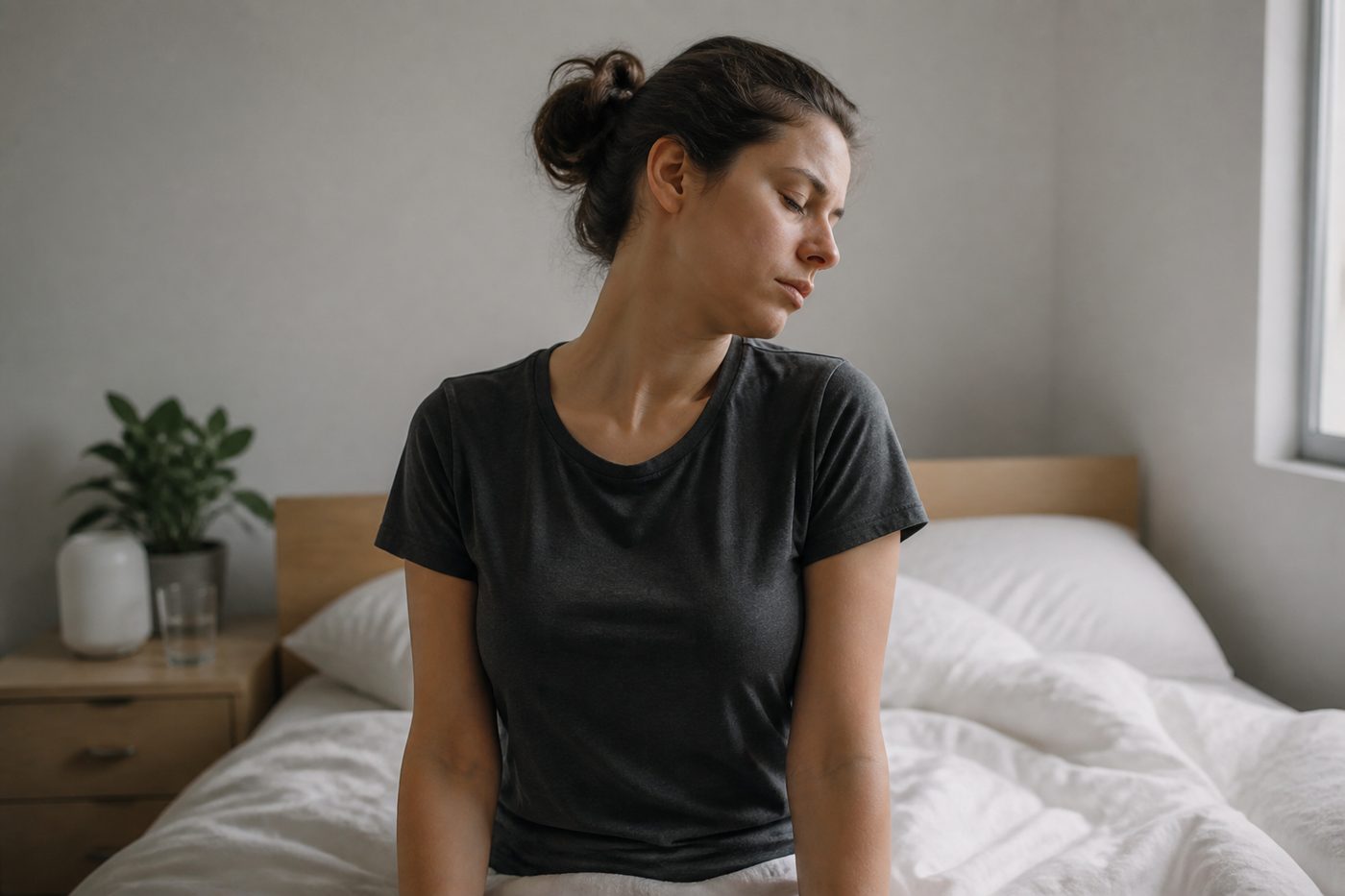
Hip dysplasia in shepherd breeds asks two bodies to carry the same problem. The dog carries the joint, the pain and the changing gait. The owner carries the daily walk, the harness, the car boot and the lifting. When the dog's movement changes, the owner's back usually changes with it, often without anyone noticing until the ache settles in.
What does hip dysplasia ask of the dog?
Hip dysplasia is a developmental condition in which the hip joint does not form a stable fit. The femoral head sits loosely in the socket, and over months the joint surface takes uneven load. In German Shepherds, Australian Shepherds and other shepherd breeds, the result is often a dog that moves well as a puppy and then gradually changes.
The signs are rarely dramatic at first. A dog may sit slightly to one side, swing the hind legs rather than push through them, or rise more slowly after rest. Stairs become a decision rather than a habit. Some dogs shift weight forward onto the front legs, which is why shoulder soreness can appear in a dog whose problem is at the back. Others lose muscle over the hips while the front end grows heavier.
What the condition asks of the dog is a change in how it uses its whole body. A shepherd breed is built to trot, turn and cover ground. When the hips are uncomfortable, the dog finds a way to keep going, and that compensation is often the first thing a vet or an experienced owner notices. Understanding that pattern is the starting point of the material on hip dysplasia in shepherds, which covers recognition, diagnosis and the choices that follow.
What does the daily walk ask of the owner's back?
The daily walk is where the dog's mechanics meet the owner's. A dog with hip discomfort often pulls less than before, which sounds easier, but the change is not always kind to the person at the other end of the lead.
A dog that slows down suddenly, stops without warning or sits mid-walk creates a small jolt through the lead. Repeated several times a day, that jolt travels up the arm, across the shoulder and into the lower back. Owners learn to brace, and bracing for a short distance is fine. Bracing for twenty minutes is not.
There is also the leaning. A dog that swings its hindquarters to one side tends to drift on the lead. The owner responds by holding the arm across the body or turning the torso to keep the dog straight. That twist, held for the length of a walk, loads one side of the spine more than the other. A few weeks of it can produce a familiar one-sided ache in the lower back or between the shoulder blades.
Three practical adjustments help. First, keep the lead hand close to the body and let the arm hang rather than reach. Second, use a harness with a front attachment if the dog drifts, so the turning force goes through the chest rather than the neck and the lead. Third, shorten the route rather than the number of outings. Two shorter walks with a rest between them usually suit both backs better than one long one.
How do you lift a large dog without hurting your back?
Lifting is the moment most owners remember afterwards. A German Shepherd weighing thirty-five kilos is not a parcel, and a dog that cannot help with its hind legs is heavier than its weight suggests.
Plan the lift before you touch the dog. Put the car boot or the vet table at the height you need, or use a ramp so that the dog can walk up. If a lift is unavoidable, stand close to the dog with feet apart, one foot slightly forward. Bend at the knees and hips, keep the back long rather than rounded, and hold the dog against your body before you rise. The closer the load, the less force through the spine.
For a large dog, a two-person lift is safer. One person supports the chest and front legs, the other supports the abdomen just in front of the hind legs. Both lift on a count, and both step together. A towel or a purpose-made sling under the belly gives the second person something to hold and spreads the pressure.
Never lift and twist at the same time. Turn with the feet, not the waist. If the dog is struggling, put it down and start again. A struggling dog is an unpredictable load, and the lower back takes the surprise.
How can owners protect their own back over months and years?
Hip dysplasia is often a long-term companion. The dog may need help for years, and the owner's back has to last as long as the dog's care does.
Strength is the first defence. A simple routine of hip hinges, split squats and carries, two or three times a week, keeps the legs and trunk able to do the lifting that the arms should not. Walking itself is useful, but only if the posture on the lead is not working against you.
Recovery matters as much as effort. After a difficult walk or a vet visit, lie on your back with the knees bent for a few minutes, or kneel with the hips back towards the heels. These positions take load off the lower back without stretching anything forcefully.
Sleep is part of the same picture. A mattress that lets the hips sink below the shoulders keeps the spine closer to neutral. Owners who wake stiff after a night of broken sleep, often because the dog is restless, tend to carry that stiffness into the morning walk.
Finally, share the physical work. If two people live with the dog, the lifting, the car journeys and the longer walks can be divided. If you live alone, ask the vet practice about slings, ramps and harnesses that reduce the number of lifts rather than making each one easier.
When should an owner see someone about their own back?
See a clinician if the ache lasts more than a few weeks, if it wakes you at night, if it travels down a leg, or if there is numbness, weakness or a change in bladder or bowel control. Those last signs need urgent attention.
For the more ordinary pattern, a persistent one-sided ache after months of walking a dog that drifts, an assessment is a sensible step. It can separate a simple strain from something that needs a different approach, and it gives you a baseline to compare against if the dog's needs change again.
The same principle applies to the dog. A vet assessment, radiographs and a clear plan make the daily decisions easier, and they make it possible to adjust the walking and lifting routine before either body is worn down by it.
What the two of you share
A shepherd breed with hip dysplasia and an owner with a sore back are not two separate problems. They are one household managing a changing load. The dog adapts its gait, the owner adapts the lead, and both adaptations have a cost if they are repeated without thought.
The useful work is unglamorous. Shorter walks, a harness that fits, a ramp instead of a lift, a few minutes of strength work, and a willingness to ask for help with the heaviest parts. None of it reverses the dog's joint, and none of it guarantees an owner's back will stay quiet. It simply keeps the daily routine within what both bodies can carry, which is usually enough to keep the walks going.