
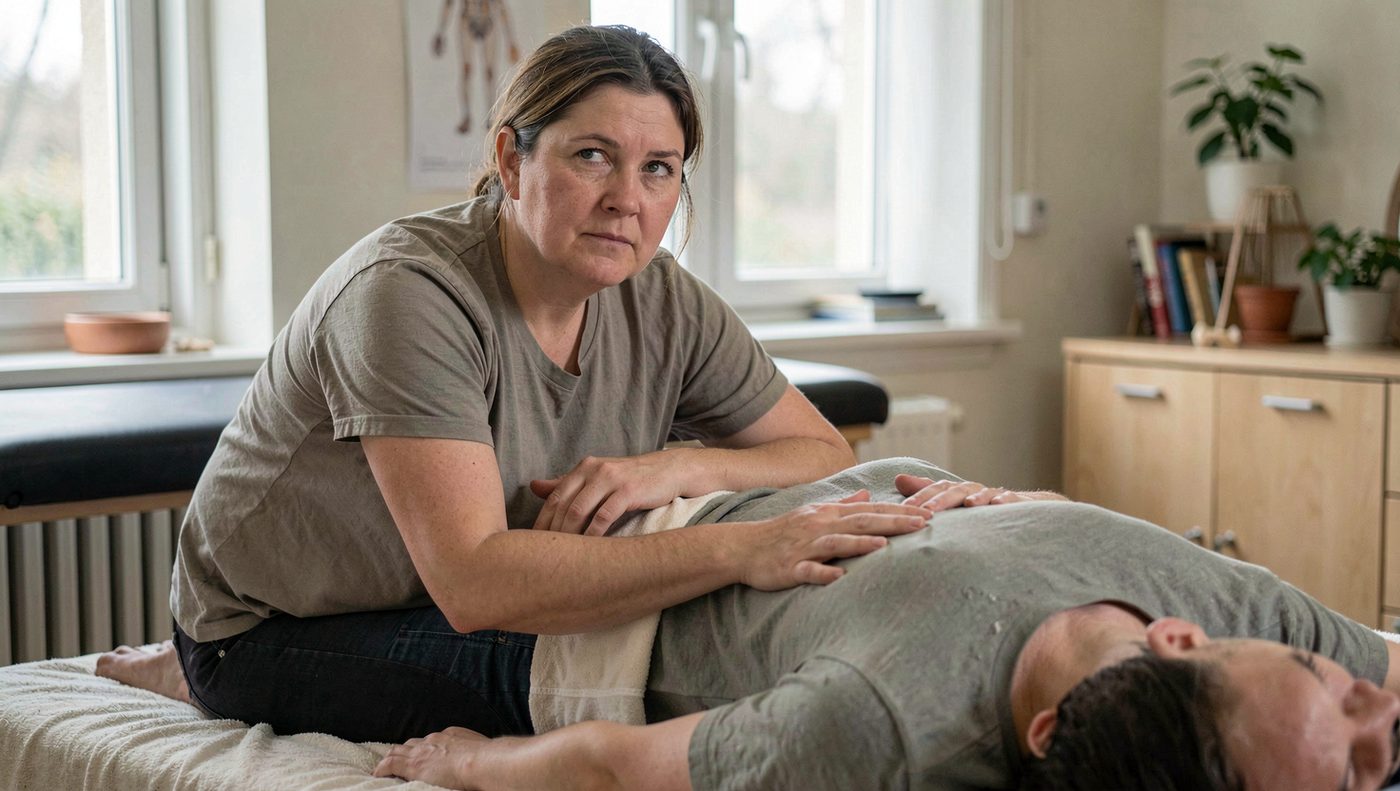
The question comes up constantly and the honest answer is unsatisfying: sometimes, in some places, through a route that is rarely advertised. Osteopathy is available on the NHS in parts of England, usually inside a wider musculoskeletal service rather than as an offer in its own name, and the great majority of people who see an osteopath in the UK pay for it themselves.
This page explains why that is, how to find out what exists in a particular area, and what the NHS does reliably provide for the problems people usually want an osteopath for.
The short answer
- Available on the NHS?
- In some areas, yes. Provision is local, limited and usually sits within musculoskeletal or physiotherapy services rather than being offered separately.
- How people usually get there
- Through a GP referral or a musculoskeletal service, where such a service happens to include osteopathy. It is not something that can be booked directly on the NHS.
- The realistic expectation
- Most people in the UK pay privately. Assuming that is the starting point, and being pleasantly surprised, is the sensible approach.
- Where to ask
- A GP surgery, which will know what is commissioned locally, and the local integrated care board or health board website.
- What is reliably free
- NHS physiotherapy, musculoskeletal assessment and, in many areas, pain management programmes. Several of these can be self referred to.
Why availability is so patchy
Two separate things are often confused. Osteopathy has been regulated by statute since the Osteopaths Act 1993, with a public register held by the General Osteopathic Council and a title protected in criminal law. That is regulation of a profession. It says nothing about whether the NHS buys the service.
What the NHS buys is decided locally. In England, integrated care boards commission musculoskeletal services for their populations, and they design those services around what national guidance recommends and what local providers can deliver. Scotland, Wales and Northern Ireland have their own arrangements through health boards and trusts. The result is genuine variation from one postcode to the next, which is frustrating and is not a bureaucratic accident so much as the design of the system.
National guidance also shapes it. NICE recommends that manual therapy, meaning spinal manipulation, mobilisation or soft tissue technique, may be considered for low back pain, but only as part of a package that includes exercise. That framing sits naturally inside a physiotherapy led service, which is where most NHS musculoskeletal provision already lives, and it gives commissioners little reason to buy manual therapy as a standalone offer.
Regulation and commissioning are different questions. A profession can be regulated in law and still be bought by the NHS in only a handful of places.
How to find out what exists locally
- Ask at the GP surgery, including the reception team, who often know the local referral routes better than anyone. The question to ask is what musculoskeletal services are available locally and whether any include manual therapy.
- Ask whether there is a first contact practitioner at the practice. Many GP surgeries now have a musculoskeletal specialist, most often a physiotherapist, who can be booked directly without seeing a GP first. It is frequently the fastest route to assessment.
- Check whether physiotherapy can be self referred to. In much of England it can, and the local NHS website will say. That removes a GP appointment from the process entirely.
- Look at the integrated care board website, or the health board equivalent in Scotland, Wales and Northern Ireland, which publishes what is commissioned.
- Use the NHS website's service finder for local musculoskeletal and physiotherapy services.
What the NHS does reliably offer for a bad back
Rather more than most people assume, and it is worth knowing before deciding to pay.
- Physiotherapy, which is the mainstay of NHS musculoskeletal care and is available in every area. Waiting times vary widely, and self referral is possible in many places.
- First contact practitioners in general practice, assessing musculoskeletal problems directly and able to arrange investigations or referrals.
- Musculoskeletal triage and assessment services, which sort where a problem belongs before it reaches a specialist.
- Pain management programmes, combining physical and psychological approaches, recommended by NICE for people whose lives are significantly limited by persistent pain. These exist in most regions and are frequently not mentioned unless asked about.
- Exercise referral schemes, where a GP or practice nurse can refer to supervised activity programmes, often at a reduced cost through local leisure providers.
Since UK guidance places exercise at the centre of back pain care in any case, an NHS physiotherapy appointment addresses the recommended treatment directly. The back pain guide sets out what that guidance actually says.
Paying privately, and what it costs
Fees are set by each practice and vary considerably by region. Published price lists in the UK commonly show a first appointment, which lasts longer, at somewhere around fifty to ninety pounds, and follow up appointments in the region of forty to eighty. Central London runs higher than most of the country, and rural areas lower.
Two things are worth knowing. Osteopathic educational institutions run teaching clinics that are open to the public, where students treat under supervision at substantially reduced fees, and these are a genuine option for anyone for whom cost is the obstacle. And some practices offer concessionary rates, which are rarely advertised and are usually available on asking.
Questions worth asking any private practitioner before booking: what the first appointment costs and how long it lasts, roughly how many sessions might be expected before a review, whether exercise advice forms part of the plan, and what happens if there is no improvement. A practitioner who cannot answer the last two is worth avoiding, and long packages of sessions sold before any assessment are a poor sign in any discipline.
Private health insurance
Many UK policies cover a course of manual therapy, and the conditions attached are fairly consistent. Most require the practitioner to be registered with the relevant regulator, which for osteopathy means the General Osteopathic Council. Many require a GP referral or prior authorisation from the insurer before the first appointment, and paying first and claiming later frequently fails on that point alone. Cover is often capped, either at a number of sessions or a total amount per year.
Some employers provide cash plans rather than full insurance, which reimburse a proportion of the cost of a set number of sessions a year. These are commonly forgotten about, and they often cover exactly this.
Two things that get confused with this question
Osteopathy in the UK is not the same as osteopathic medicine in the United States. An American Doctor of Osteopathic Medicine, or DO, is a fully qualified physician with prescribing rights and hospital training. A UK osteopath is a manual therapy practitioner regulated by the General Osteopathic Council. Searching the term online returns a great deal of American material that does not describe the UK profession at all.
Osteopathy and osteoporosis are unrelated, despite the similar sound. Osteoporosis is a condition in which bone becomes fragile, and it is managed medically. Bone health is covered here.
Anyone still weighing up which kind of practitioner to see will find the comparison page more useful than this one, and the main explainer covers what a session involves and how to check a public register.
Before booking anything, private or NHS
Numbness around the back passage, genitals or inner thighs, difficulty passing urine, loss of bladder or bowel control, weakness in both legs, back pain with fever or unexplained weight loss, pain after a serious fall, or new back pain in someone with a history of cancer are not appointments to wait for. In the UK, contact a GP or call NHS 111 without delay, and 999 if symptoms are severe or come on suddenly. What this site can and cannot do is set out on the medical disclaimer page.
Common questions
Can an osteopath be seen without a GP referral?
Privately, yes. UK osteopaths can be seen directly and no referral is needed. The usual exception is private health insurance, which often requires a referral or authorisation before it will pay.
Will a GP refer someone for osteopathy?
Only where the local service includes it, which in most areas it does not. A GP is more likely to refer to NHS physiotherapy or a musculoskeletal service, which is the recommended route in national guidance.
Is chiropractic available on the NHS?
The position is much the same: available in a small number of areas within musculoskeletal services, mostly paid for privately. Chiropractic is regulated separately under the Chiropractors Act 1994 by the General Chiropractic Council.
How long are NHS physiotherapy waits?
They vary enormously by area and by referral route, from a couple of weeks to several months. Self referral, where available, is often faster than going through a GP appointment, and a first contact practitioner at the surgery can sometimes be seen within days.
Is it worth paying privately while waiting for NHS treatment?
That is a personal decision about money and time rather than a clinical one, and it is not something a publication can answer for anyone. What is worth knowing is that most back pain improves within four to six weeks regardless, and that the exercise advice at the centre of NHS treatment is also what good private practitioners provide.
The same check-first habit applies to animals: asking a vet the same careful questions matters before routine treatments for some breeds.
The same ask-questions habit works at the breeder's kitchen table: questions for the breeder before you commit.
If the NHS route is not open to you, or the wait is long, the same practical questions still apply when you see someone privately. A family practice works in a similar way: you describe the problem, they ask about its history, and they decide what happens next. A grumbling back is worth describing in plain terms, when it started, what makes it worse, and how it affects your sleep. For a clear account of what to bring and what to expect, see preparing for a first appointment.