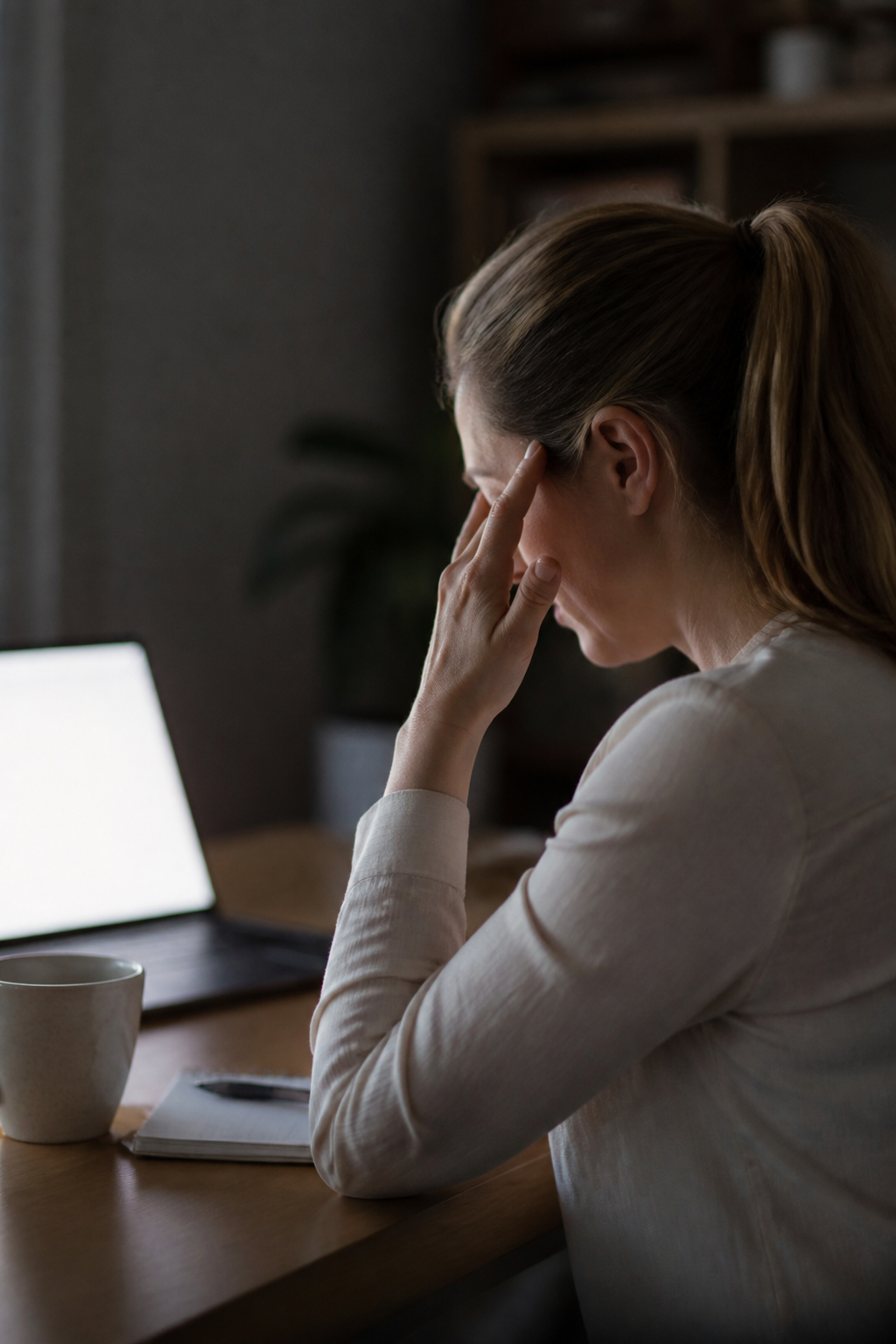
Posture is blamed for headaches more often than the evidence justifies, and dismissed more completely than the evidence justifies too. The truthful position sits between the two: the neck can be a genuine source of headache, it is a less common source than the internet suggests, and several other things about a working day cause headaches that get attributed to posture because posture is the visible suspect.
The short answer

Sustained neck and shoulder positions can contribute to headaches, particularly tension type headaches and a specific pattern called cervicogenic headache where the upper neck is the source. What has not been demonstrated is that any particular posture causes headaches on its own. Studies comparing measured head and neck position in people with and without headaches find heavily overlapping results, and plenty of people with pronounced forward head posture never get a headache at all.
What is far better supported is that how long a position is held matters, that neck and shoulder endurance exercise helps some headache types, and that the desk is only one of several plausible culprits in an office day.
The neck is a real suspect. It is rarely the only one in the room, and it is often not the guilty party.
Three headaches that get confused with each other
- Tension type headache, the most common kind. Typically a dull, pressing band across the forehead or around the head, on both sides, mild to moderate, not made worse by ordinary activity, without nausea or sensitivity to light. Neck and shoulder tenderness often accompanies it.
- Cervicogenic headache, where the source is in the upper neck and the pain is referred to the head. Usually one sided and consistently the same side, starting at the back of the head or neck and spreading forward, provoked by neck movement or by holding a position, with reduced neck movement on examination.
- Migraine, which is where much of the confusion comes from. Neck pain is extremely common in migraine, reported by a large majority of people who have them, and it frequently arrives before the headache does. That means a great many migraines get attributed to a bad night at the desk. Migraine is typically one sided and throbbing, worsened by activity, and accompanied by nausea, or sensitivity to light and sound, though not always.
Getting this distinction right matters, because migraine has effective specific treatments that are wasted if the problem is being treated as a posture issue.
What the neck genuinely contributes
The mechanism for cervicogenic headache is reasonably well described. The nerves supplying the top three segments of the neck share a relay point in the brainstem with the nerve that supplies sensation to the face and much of the head. Signals from the upper neck can therefore be perceived as pain in the head, and that convergence is not controversial.
What follows from it is more modest than the popular version. A neck held at the end of its range for long periods, or a set of neck and shoulder muscles working continuously without rest, can plausibly feed that system. Duration is doing the work rather than shape. This is also why the ache and the headache often arrive on the same schedule, mid to late afternoon, and ease within an hour or two of finishing. The screen time page covers that pattern in the shoulders.
The other desk causes, which are often the real ones
- Eye strain and uncorrected vision. Extremely common and easily missed. Employees who use screens significantly are entitled under UK regulations to an eye and eyesight test paid for by their employer, and to a contribution towards basic spectacles needed specifically for screen work.
- Glare and contrast. A window behind the screen, an overly bright display in a dim room, or reflections across the surface all make the eyes work harder for hours.
- Dehydration and skipped meals. Unglamorous, well established, and characteristic of a day that got away from someone.
- Caffeine, in both directions. Too much, and withdrawal from the usual amount, both cause headaches. A late morning drop in intake explains a surprising number of afternoon headaches.
- Jaw clenching. Frequently unnoticed and often worse under pressure or at night. Jaw ache, headache around the temples and worn teeth travel together.
- Poor or short sleep, which is one of the more reliable headache triggers there is.
- Stress itself, which raises baseline muscle tension and lowers pain thresholds at the same time. That mechanism is set out here.
The painkiller trap
This deserves more attention than it usually gets. Taking painkillers frequently for headaches can, over time, cause headaches, a condition known as medication overuse headache. UK guidance describes it in fairly specific terms: taking simple painkillers such as paracetamol or ibuprofen on fifteen or more days a month, or triptans, opioids or combination painkillers on ten or more days a month, for three months or more.
The pattern is cruel, because it looks exactly like a worsening headache problem being managed with increasing medication. It is common, it is under recognised, and the treatment involves stopping the offending medication, which typically makes things worse for a period before it improves. That is not something to attempt alone: it is a conversation with a GP.
Anyone taking something for headaches on more than a couple of days a week, for months, should count the days honestly and mention the number at their next appointment.
What actually helps
- Neck and shoulder endurance exercise. The intervention with the most support for both tension type and cervicogenic headache. Chin nods, wall slides, shoulder blade squeezes and band rows, twice or three times a week, with a fair trial being six to eight weeks.
- Changing position more often. Every twenty to thirty minutes, which addresses the duration problem directly.
- The 20-20-20 habit. Every twenty minutes, look at something roughly twenty feet away for twenty seconds. Aimed at the eyes rather than the neck, and it costs nothing.
- Getting the screen right. Top line at around eyebrow height, an arm's length away, directly in front, no window behind it. The screen section of the desk guide goes through it.
- Regular sleep, meals and fluid. Dull, and among the more effective things on the list.
- An eye test, if it has been more than two years, or if headaches are accompanied by any change in vision.
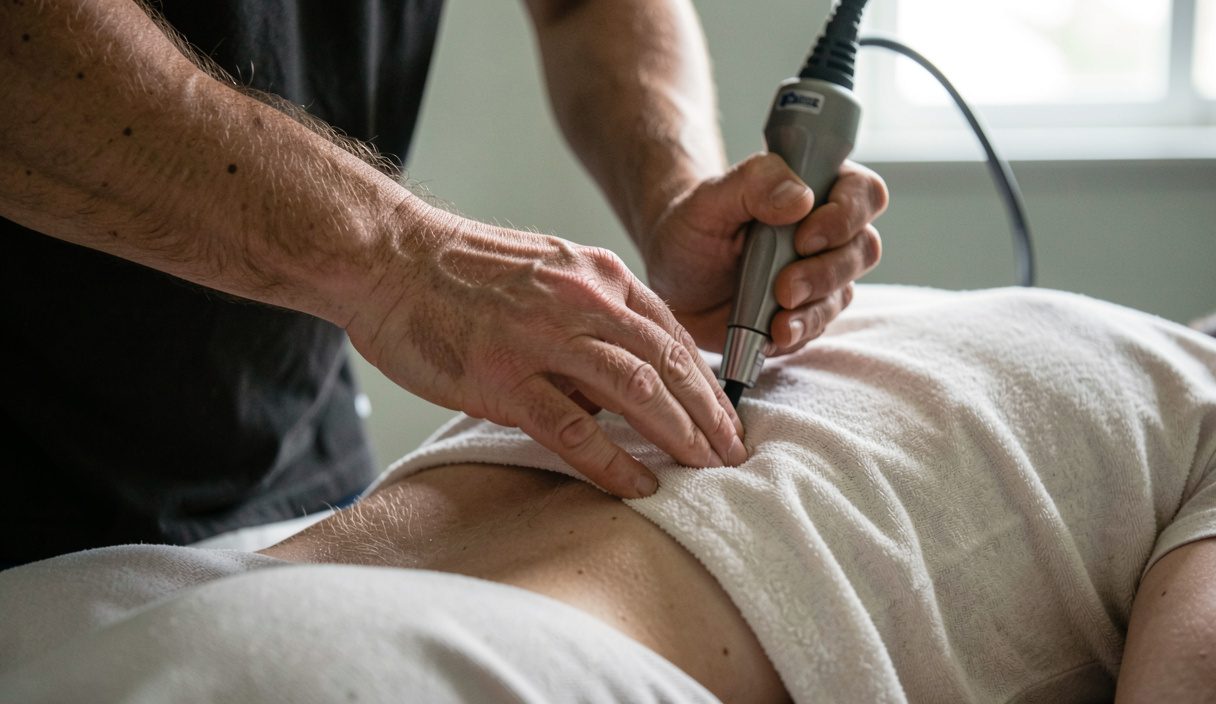
Manual therapy has some evidence for cervicogenic headache specifically, generally alongside exercise rather than instead of it. How UK manual therapy is regulated covers how to check a practitioner's registration before booking.
Keeping a headache diary that is worth reading
Two weeks of notes will tell a GP more than any description from memory, and it is the single most useful thing to bring to an appointment. Record the date and time it started, how long it lasted, where the pain was and what it felt like, what was happening beforehand, anything taken for it and whether it helped, plus sleep, meals, caffeine and, for anyone who menstruates, the point in the cycle.
Patterns show up quickly. Headaches that only ever appear on working days, only after short nights, or reliably on the first day of a holiday all point in different directions, and none of those patterns is visible without writing it down.
Headaches that need urgent attention
A sudden severe headache reaching maximum intensity within seconds, a headache with fever, neck stiffness, a rash or confusion, a headache following a head injury, one that is consistently worse when lying down or when coughing, straining or bending, a new headache in someone over fifty especially with scalp tenderness or jaw pain when chewing, a headache with weakness, numbness, visual loss or difficulty speaking, or a severe headache in pregnancy with visual disturbance or swelling. In the UK, contact a GP or call NHS 111 without delay, and 999 if symptoms are severe or come on suddenly. What this site can and cannot do is set out on the medical disclaimer page.
Common questions
Can text neck cause headaches?
The term comes from a modelling study that estimated forces on the neck at different angles. It calculated loads, it did not demonstrate harm, and no study has shown that phone use causes headaches. Long unbroken periods in any position are a more defensible concern than the angle itself.
Would a new pillow help?
Possibly, if headaches are worst on waking and the pillow is the wrong height for the usual sleeping position. It is a cheap experiment. The pillow section here explains how to judge it.
How long before exercise makes a difference to headaches?
Six to eight weeks of consistent neck and shoulder work is a fair trial. Most people stop at two, decide it has not worked, and never find out.
Do blue light glasses help?
The evidence for blue filtering lenses reducing eye strain or headaches is weak. Screen distance, brightness relative to the room, glare, breaks and a current spectacle prescription have considerably more behind them.
When is a headache worth a GP appointment?
When the pattern changes, when frequency increases, when painkillers are being taken on more than a couple of days a week for months, when headaches are disrupting work or sleep, or if anything in the urgent list above applies. A two week diary makes that appointment far more productive.
Breaks work better with a reason; a walk with a purpose is easier to keep than a step count.