
The pattern is familiar to almost anyone who works on a screen. Nothing at nine in the morning, a vague tightness after lunch, and by half past three a burning ache across the top of the shoulders and up into the base of the neck that no amount of rolling the shoulders will shift.
That timing is the most useful piece of information in the whole complaint. Pain that arrives at roughly the same hour every working day and improves at weekends is a fatigue pattern, not an injury, and fatigue patterns respond to changing the load rather than to treating the sore spot.
Why the ache arrives in the afternoon
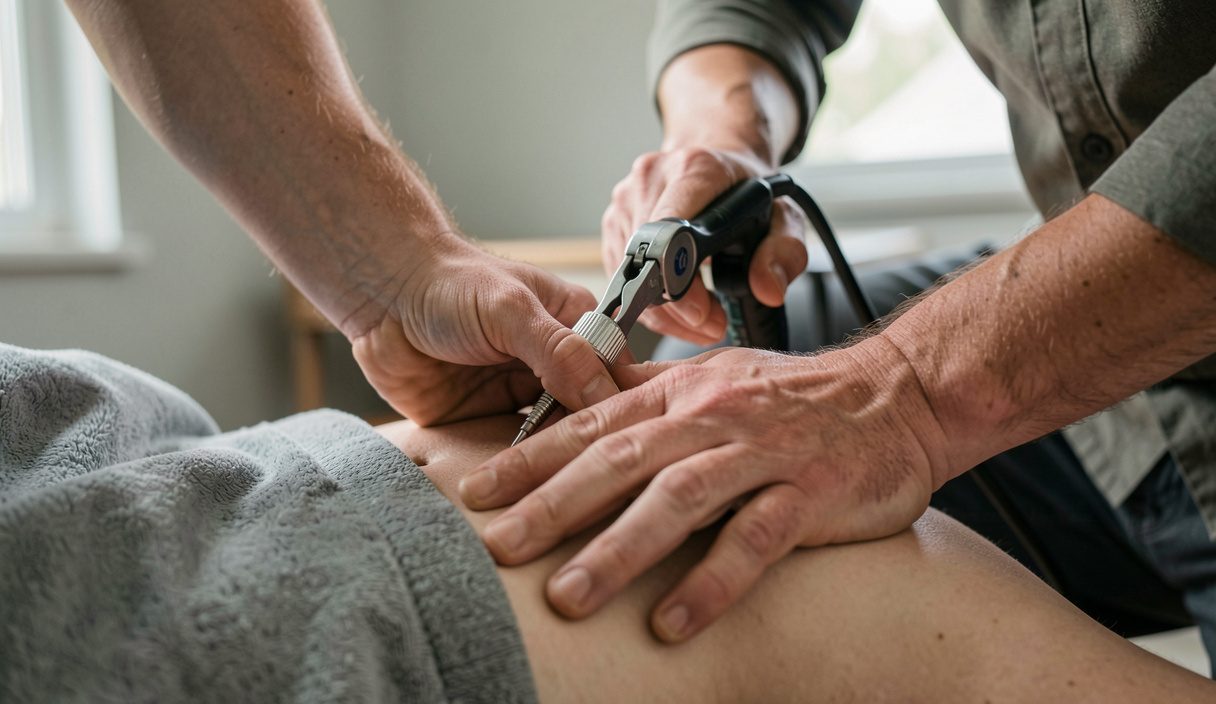
The muscles across the top of the shoulders, principally the upper trapezius and the levator scapulae, are built for holding the shoulder blade and supporting the arm. At a desk they are asked to do that continuously, at a low level, for hours, with no rest between contractions.
Muscles cope badly with that. A low but unrelenting demand recruits the same small pool of muscle fibres for the entire period, and those fibres become progressively more irritated while the rest of the muscle sits idle. The result is a slow build to a predictable point of discomfort, followed by relief within an hour of stopping. It is the same reason holding a full mug at arm's length becomes unbearable long before the mug becomes heavy.
A weight the muscle could hold for twenty minutes without noticing becomes intolerable at four hours. Nothing about the weight changed.
The four things at a desk that cause it
- Unsupported arms. An arm weighs roughly five to six kilograms. If it is not resting on a desk or an armrest, the shoulder holds that weight all day. This is the single biggest contributor and the easiest to fix.
- A mouse too far away. Reaching forward and out to the side for the mouse, usually across a wide keyboard with a number pad, holds the arm in a small permanent reach. Bring the mouse next to the keyboard, or use a compact keyboard.
- Armrests set too high, which shrugs the shoulders for eight hours. Set them so the forearms rest without any lift at the shoulder, or take them off.
- A screen in the wrong place, either too low, which drops the head forward, or off to one side, which turns the neck for the whole day. A laptop parked to the left of a monitor is the classic offender.
Stress belongs on the list too, indirectly. Resting muscle tension across the shoulders rises with workload and anxiety, so a demanding week starts the afternoon ache earlier. That mechanism is covered separately, and it is not a soft factor.
Changing the setup, which is the actual fix
Roughly in order of how much difference each one makes.
- Support the forearms. Pull the chair close enough that the forearms rest on the desk while typing, or set the armrests to take the weight. Nothing else on this list matters as much.
- Bring the mouse in. It should sit immediately beside the keyboard, at the same height, reachable without moving the elbow away from the body.
- Raise the screen and square it up. Top line of text at around eyebrow height, directly in front, an arm's length away.
- Check the chair height. If the desk is too high relative to the chair, the shoulders shrug permanently no matter what else is adjusted. The chair guide sets the order to work through.
- Add a headset for anyone who holds a phone against one ear regularly. Cradling a handset is a shoulder problem waiting to happen.
Movements that ease it during the day
These provide relief rather than a cure, and they work best used little and often instead of once when it already hurts.
- Shoulder rolls. Ten slow backward circles, letting the shoulder blades move rather than just the shoulders. The simplest and most underrated one.
- Shoulder blade squeezes. Draw the blades gently together and down, hold five seconds, release. Ten repetitions. Down matters more than together.
- Neck side bend. Ear towards the shoulder, opposite hand holding the edge of the chair to keep that shoulder down. Twenty to thirty seconds each side, no bouncing.
- Levator stretch. Turn the head about forty five degrees towards the armpit and look down, gently guiding with the hand. Twenty seconds each side. This reaches the muscle that runs from the neck to the top corner of the shoulder blade, which is often the exact sore spot.
- Doorway chest opener. Forearms on the frame, elbows at shoulder height, step gently through. Thirty seconds. The counterweight to a day spent reaching forward.
Building the endurance to stop it returning
Stretching a fatigued muscle feels good and does not make it more resilient. What changes the following month is endurance in the muscles that hold the shoulder blade, and two short sessions a week is enough to shift it.
Wall slides, band pull aparts, rows with a resistance band anchored in a door, and simple prone or bent over shoulder blade retractions all target the middle and lower trapezius, which are the muscles that let the upper trapezius stop doing everything. Ten to fifteen repetitions, two or three sets, twice a week. Expect the first noticeable difference at around week four and a real one by week eight.
This is also the general pattern for desk related aches. The setup change removes the cause, the movements manage the day, and the strength work is what stops it coming back when the next busy fortnight arrives.
Shoulder symptoms that need assessing
Pain following a fall or a wrench, an arm that cannot be lifted, obvious weakness, numbness or pins and needles that persist, a shoulder that feels unstable, or pain that wakes you every night rather than easing with rest all need a clinical assessment. Chest tightness, jaw or arm pain with breathlessness or sweating is a medical emergency. In the UK, contact a GP or call NHS 111 without delay, and 999 if symptoms are severe or come on suddenly. What this site can and cannot do is set out on the medical disclaimer page.
When shoulder pain is a shoulder problem
Desk related ache is diffuse, across the top of the shoulders, worse in the afternoon and better at weekends. Shoulder joint problems tend to be different in character: pain deeper in the joint or down the outer upper arm, worse with specific movements such as reaching overhead or behind the back, often worse at night when lying on that side, and not obviously related to what the working day contained.
Frozen shoulder, rotator cuff irritation and shoulder impingement all sit in that second group and are worth a proper assessment rather than a new mouse mat. Persistent pain running down one arm with pins and needles points towards the neck rather than the shoulder, which is another reason to see someone rather than to keep adjusting the desk.
Common questions
Why does it stop at the weekend and come back on Monday?
Because the load is the working day. That weekly rhythm is the clearest possible sign that the answer lies in the setup and in how often position changes, rather than in the tissue itself.
Does massage help?
It provides genuine short term relief for many people and does not change the cause. Used alongside setup changes it is a reasonable comfort. Used instead of them it becomes a fortnightly subscription to the same problem.
Would a standing desk fix it?
Not on its own. Standing with unsupported arms at a badly placed screen produces the same shoulder load as sitting. What helps is alternating, plus supporting the forearms in whichever position is being used.
Is it caused by a weak core?
No. Trunk strength is useful for other reasons, and shoulder ache from screen work is a local endurance problem in the muscles holding the shoulder blade. Train those.
How long before setup changes make a difference?
Often within a week, because the ache is a response to daily load rather than damage. If nothing has changed after three or four weeks of a properly adjusted desk, it is worth having it looked at.
Loads carried badly ache by evening; carrying kit without a sore shoulder applies the same idea to a camera bag.