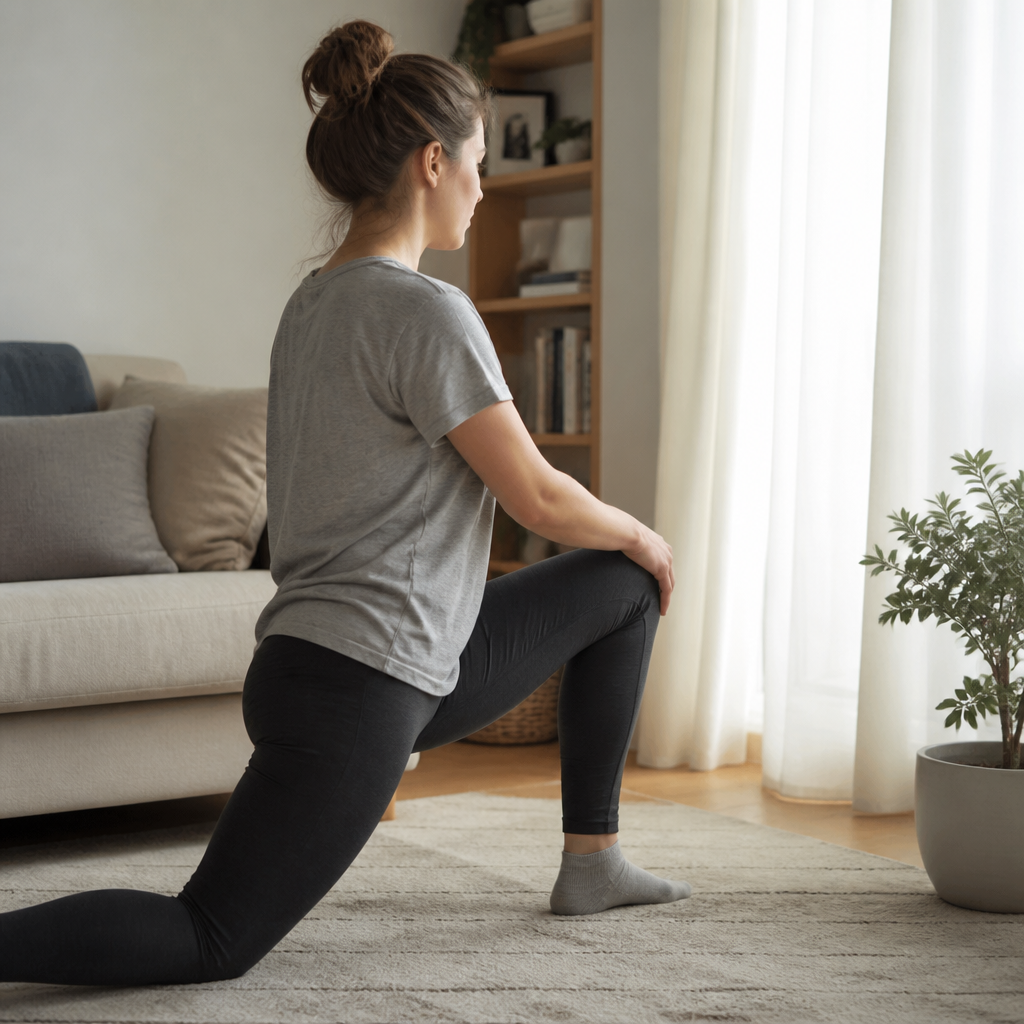
Eight hours of sitting keeps the hip in the same position for most of the waking day: bent to roughly ninety degrees, with the muscles at the front of the hip held short and the ones at the back held long and largely switched off. Standing up from that and immediately walking to the station is why the first hundred yards of an evening often feel stiff.
The stretches below take five minutes, need no mat and no equipment, and can be done in work clothes in a kitchen. They are also, honestly, the second most useful part of this page. The first is the paragraph about strength further down.
What sitting actually does to a hip
The main muscles at issue are the hip flexors, chiefly the iliopsoas running from the lower spine and pelvis to the top of the thigh bone, and rectus femoris, which crosses both the hip and the knee. Sitting holds both in a shortened position. The glutes on the other side are held long and are barely used at all, which is why they contribute so little to standing up until asked to.
Whether this genuinely shortens tissue over time, or whether the sensation of tightness is largely the nervous system objecting to a position it has been stuck in, is still debated. For practical purposes it does not matter much: both explanations point at the same solution, which is to change hip position more often and to move the joint through its full range regularly.
Tightness is often less about the length of a muscle than about how long it has been asked to stay still.
A two minute self check
An adapted version of a test clinicians use, which gives a rough sense of whether the front of the hip is genuinely restricted.
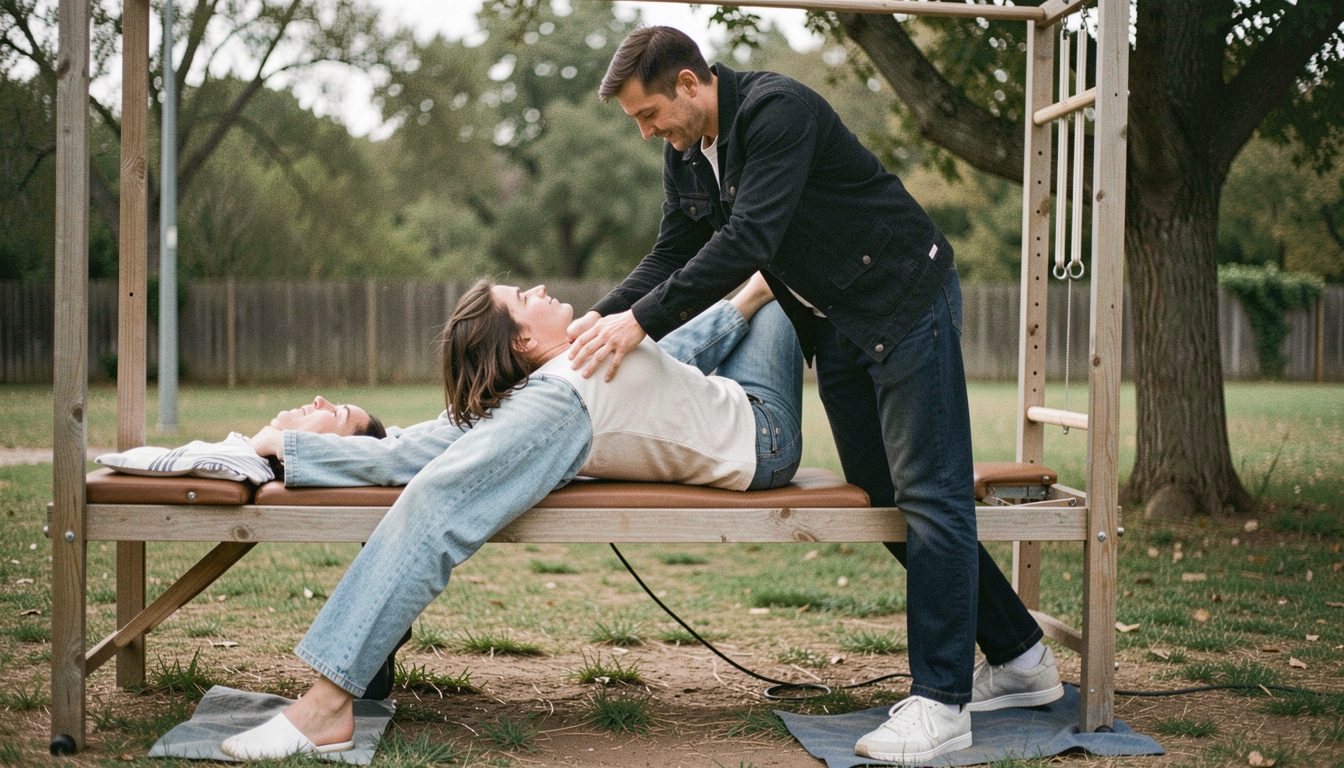
Sit on the very edge of a firm bed or table so the back of the thigh is just off the surface. Pull one knee up towards the chest and hold it there, then lie back so the trunk is flat on the surface and let the other leg hang freely. If the hanging thigh rests flat, roughly level with the surface, the hip flexors on that side have reasonable length. If it hovers noticeably above it, the front of that hip is tight. If the hanging knee straightens out as it drops, rectus femoris is the tighter of the two.
Compare the sides. Most people find one is worse, usually the side they habitually cross their legs towards or the driving leg. This is information rather than a diagnosis, and asymmetry on its own is not a problem to be alarmed by.
Five stretches, no mat required
- Standing kitchen lunge. One foot forward, hands on the counter, tuck the tailbone under and shift weight gently forward until a stretch is felt at the front of the back hip. Thirty seconds each side. The tailbone tuck is the part everyone skips and the part that makes it work.
- Half kneeling hip flexor. Kneel on a cushion, one foot forward, squeeze the buttock on the kneeling side and ease the hips forward. Thirty seconds each side. Better than the lunge if there is floor space.
- Figure four, seated. Ankle across the opposite knee, sit tall, hinge forward from the hips until a stretch appears deep in the buttock. Thirty seconds each side. This one can be done at a desk without anyone noticing.
- Standing hamstring reach. Heel on a low step or chair rung, leg straight, hinge forward from the hips with a long back rather than rounding. Thirty seconds each side.
- Hip circles. Hold the counter, lift one knee and draw five slow circles in each direction. Not a stretch, but the best of the five for restoring the sense of a joint that moves freely.
Once a day is plenty, and the end of the working day is the natural slot. Holds of twenty to thirty seconds are enough. Bouncing achieves nothing and is a good way to strain something.
Do tight hips cause back pain?
This is where the internet becomes confident and the evidence becomes cautious. The popular version runs: sitting shortens the hip flexors, short hip flexors tip the pelvis forward, a tipped pelvis exaggerates the curve in the lower back, and that causes pain. It is a tidy chain and each link is weaker than it looks.
Studies measuring pelvic tilt in people with and without back pain find heavily overlapping ranges. Trials that stretch hip flexors do not reliably resolve back pain. And plenty of people with genuinely restricted hips have never had a sore back.
What is reasonable to say is that stiff hips make the lower back do more of the work in movements the hip should lead, particularly bending to pick things up. Restoring hip range makes that easier, which is a good enough reason to spend five minutes on it without needing the causal story to be true. The back pain guide takes the broader view of what actually predicts an episode.
Why strength usually beats stretching here
A hip that has been sitting all day is not only short at the front. It is weak at the back, because the glutes have been switched off since breakfast, and weak muscles feel tight in a way that no amount of stretching resolves.
Three exercises cover it, twice a week, no equipment:
- Glute bridges. On the floor, feet flat, lift the hips by squeezing the buttocks rather than arching the back. Two sets of twelve.
- Sit to stand from a dining chair, without using the hands. Two sets of ten. It is a squat that ordinary life already demands.
- Split squats, one foot forward, one back, lowering the back knee towards the floor. Two sets of eight each side, holding a counter for balance at first.
Four to six weeks of that will change how hips feel considerably more than daily stretching will, and the two together work better than either alone. The same principle applies across most desk related complaints, which is why the stretching page is fairly blunt about what stretching does and does not deliver.
Hip symptoms that need a clinician
Groin pain that is getting steadily worse, a hip that gives way or locks, pain after a fall, pain that wakes you every night, a limp that will not settle, pain with fever, or a deep ache down the front of the thigh into the knee that does not vary with activity all deserve assessment rather than a stretching routine. In the UK, contact a GP or call NHS 111 without delay, and 999 if symptoms are severe or come on suddenly. What this site can and cannot do is set out on the medical disclaimer page.
When hip pain is not stiffness
Stiffness from sitting feels like a restriction at the front of the hip that eases within a few minutes of walking. Hip joint problems tend to feel different: pain in the groin rather than the outside, pain on turning in bed or putting socks on, and a range of movement that does not improve with warming up. Osteoarthritis of the hip is common with age and responds well to exercise and strength work, but it should be identified rather than guessed at.
Pain on the outer point of the hip, worse when lying on that side, is usually a tendon problem rather than the joint, and it typically gets worse rather than better with aggressive stretching across the body. That is a common and avoidable mistake.
Common questions
How long does it take to loosen tight hips?
Day to day comfort often improves within a week or two. Genuine changes in range take six to eight weeks of consistent work, and they hold better when strength work is included rather than stretching alone.
Should stretching hurt?
No. A stretch should feel like a firm pull that is comfortable to hold and settles slightly during the hold. Sharp pain, pins and needles or pain that lingers afterwards means it has gone too far.
Is it better to stretch in the morning or the evening?
Evening tends to be more comfortable, since tissue has been warm and moving all day. The practical answer is whichever time will actually happen consistently.
Does crossing your legs cause tight hips?
Crossing the legs is not harmful in itself. Always crossing the same way for hours is a mild asymmetry worth alternating rather than eliminating. The duration is the issue, not the position.
Do standing desks prevent this?
They help, in that the hip spends less of the day bent. Standing still for hours brings its own fatigue, so alternating is what matters. The desk guide covers where sit stand desks genuinely sit in the order of priorities.
Hips that sit all day want movement after; walking as the antidote to sitting is the habit a dog supplies.
The next step after loosening up is movement itself; moving again after a stiff spell has its own rules.
Hips that feel tight after a day in a chair often loosen with a few slow stretches, but the way you move across a whole lifetime matters just as much. Steadiness, balance and the small habits that protect joints begin early and continue through every stage, from pregnancy and the first thousand days to older age, when preventing falls keeps independence intact. If you are unsure where to start, a personal prevention plan can be built around your own routine. Stretching helps today; steady steps help for decades.