Stretching occupies an odd position in health advice. Almost everyone believes it is good for them, almost nobody can say precisely why, and the specific claims made for it have a poor record when tested. It is neither the cure it is sold as nor the waste of time that some of the debunking suggests.
This page separates the parts that hold up from the parts that do not, and then sets out a routine short enough to actually happen on a Tuesday.
What stretching reliably does
- Increases range of motion
- The best supported effect by a distance. Regular stretching increases how far a joint will move, usually noticeable within three or four weeks.
- Improves stretch tolerance
- Much of the early gain is the nervous system becoming more comfortable at the end of range rather than tissue physically lengthening. That is still a genuine and useful change.
- Feels good
- Underrated as a reason. Something that provides immediate relief from a day of stillness does not need a further justification.
- Creates a pause
- Five minutes of deliberate movement breaks up sitting, which is protective in itself. The stretching may be doing less of the work here than the standing up.
- Possibly helps circulation
- A small but growing set of trials suggests regular static stretching may modestly improve arterial function and blood pressure. Interesting, early, and not yet a reason to prescribe it.
What it does not do, despite the claims
- It does not prevent injury. This is the most persistent claim and the one with the weakest support. Reviews of stretching before sport consistently fail to find a meaningful reduction in injury rates. Warming up properly does help, and warming up is not the same as stretching.
- It barely touches next day soreness. Trials of stretching before or after exercise find effects on muscle soreness so small as to be practically meaningless. The stretch you do after a run will not save you from Tuesday.
- It does not lengthen muscles permanently in a few weeks. Short term flexibility gains are largely about tolerance. Lasting structural change requires prolonged, loaded work over months.
- It does not fix posture. Tight muscles are frequently a consequence of a position held for hours rather than the cause of it. Stretching them provides relief without changing what produced the tightness. The posture guide covers what does.
- It does not resolve back pain on its own. Exercise helps back pain and stretching is a small component of exercise. Stretching alone has a modest record.
Stretching is a good habit sold with bad reasons. The honest ones are still good enough.
How long, how often, how hard

The parameters that appear across exercise science guidance are unglamorous and worth knowing, because most people stretch for far too short a time and then wonder why nothing changes.
- Hold for twenty to thirty seconds. Anything under ten achieves very little. Holding for two minutes is not proportionally better.
- Two to four repetitions per muscle group, aiming for roughly sixty seconds of total time on each. That is the figure that appears most consistently in the research.
- Two to three days a week is the minimum for measurable change. Daily is fine and slightly better, which is where the popular advice comes from.
- Stretch to mild tension, not pain. A firm pull that eases slightly during the hold. Sharp pain or pins and needles means back off.
- Do not bounce. Ballistic stretching offers no advantage for general flexibility and is a good way to strain something.
- Warm tissue responds better, which is why the end of the day or after a walk works better than first thing on a cold morning.
Before exercise, after exercise, or neither
Long static stretches immediately before something explosive can temporarily reduce strength and power output, an effect that appears mainly with holds beyond about a minute. For most people going for a walk or a swim this is irrelevant. For anyone sprinting, jumping or lifting heavy, it matters enough to change the order.
The sensible arrangement is a dynamic warm up before, meaning movements through range that gradually raise the heart rate, such as leg swings, arm circles, walking lunges and a few minutes of easy movement. Save the long static holds for afterwards, or for a separate session entirely, which is where they fit best anyway.
A five minute daily routine
Aimed squarely at people who sit for a living. No mat, no floor space needed for most of it, and it can be done in work clothes.
- Doorway chest opener, forearms on the frame at shoulder height, stepping gently through. Thirty seconds, twice.
- Neck side bend, ear to shoulder, opposite hand holding the chair seat. Twenty five seconds each side.
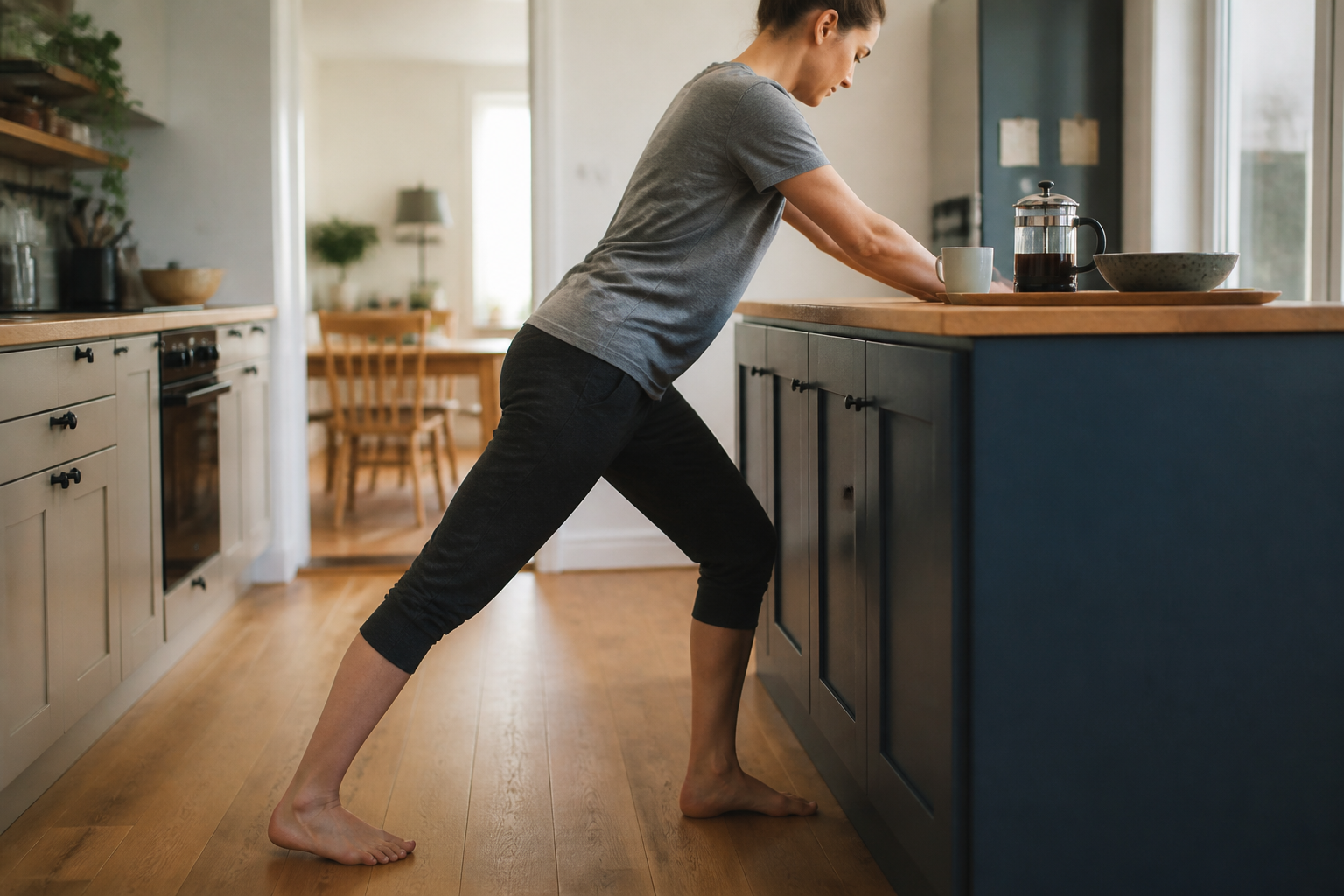
- Standing hip flexor lunge, hands on the counter, tailbone tucked under, weight shifting forward. Thirty seconds each side. More on hips here.
- Standing hamstring reach, heel on a low step, hinging forward from the hips with a long back. Thirty seconds each side.
- Calf stretch at the counter, back leg straight, heel down, leaning forward. Thirty seconds each side.
- Seated figure four, ankle across the opposite knee, hinging forward from the hips. Thirty seconds each side.
- Standing back extension, hands on the hips, leaning gently backwards. Five slow repetitions, not held.
Roughly five minutes end to end. The last one is not really a stretch and is arguably the most useful item on the list for anyone who has been sitting since nine.
The thing that works better than stretching
Moving a joint through its full range under some load. Squatting to a low chair, reaching overhead with a light weight, lunging, carrying shopping, hanging from a bar. Loaded movement through range improves flexibility at least as well as passive stretching and builds strength at the same time, which passive stretching does not.
UK Chief Medical Officers' guidance asks for muscle strengthening on at least two days a week alongside 150 minutes of moderate activity, and for adults over sixty five it adds balance work on two days. None of that mentions stretching, which tells you something about where it sits in the order of priorities.
Which is not an argument for stopping. Five minutes of stretching is a good habit that costs almost nothing, provides genuine relief and gets people out of a chair. It is simply not a substitute for the twenty minutes that does the heavy lifting.
When stiffness needs looking at rather than stretching
Morning stiffness lasting more than half an hour for weeks, joints that are swollen, hot or red, a joint that locks or gives way, stiffness alongside fever or unexplained weight loss, or pain that shoots down a limb with numbness or weakness are all reasons to see a clinician rather than to stretch harder. In the UK, contact a GP or call NHS 111 without delay, and 999 if symptoms are severe or come on suddenly. What this site can and cannot do is set out on the medical disclaimer page.
Common questions
Is it better to stretch in the morning or the evening?
Evening tends to be more comfortable because tissue has been warm and moving. Morning stretching is fine, just gentler and after a short walk about rather than straight out of bed. The best time is the one that will still be happening in a month.
Does yoga count?
Yes, and it usually does more than a stretching routine because it combines range of movement with load and balance. It has a reasonable evidence base for back pain specifically.
Why do some people never become flexible?
Natural range varies enormously, largely because of the shape of the bones and joints rather than the muscles. Someone whose hip sockets are deeper will not achieve the same range as someone whose are shallower, however diligently they stretch. Comparing yourself to a photograph is a poor plan.
Can you stretch too much?
Yes, though it is uncommon in people who sit at desks. Aggressive stretching into pain can irritate tissue, and it is a particularly poor idea for pain around a tendon, such as the outer point of the hip, where compressive stretching often makes things worse.
Should stretching happen during a painful back episode?
Gentle movement, yes, and there is a more suitable starting set for that. The gentle exercise page sets out what to do and how much soreness is acceptable.
Stretching is not the only repeatable habit; the dog's daily walk counts as movement too.
The habit carries into the weekend: a physical Saturday done kindly depends on the same pacing.
Daily stretching is worth keeping for how it feels and for the movement it preserves, not for promises it cannot make. It will not undo a day of sitting, and it will not replace strength work or a proper look at a stubborn back. What it can do is keep the habit of moving, which matters at every stage of life, from pregnancy through the first thousand days and into older age. If you want to think about staying steady on your feet over the long term, prevention at every age sets out a calm, practical view.