The instruction to exercise a painful back sounds, at first, like a poor joke. It is nevertheless the strongest single recommendation in UK guidance for low back pain, and the reason is that rest has been tested against movement repeatedly and lost every time.
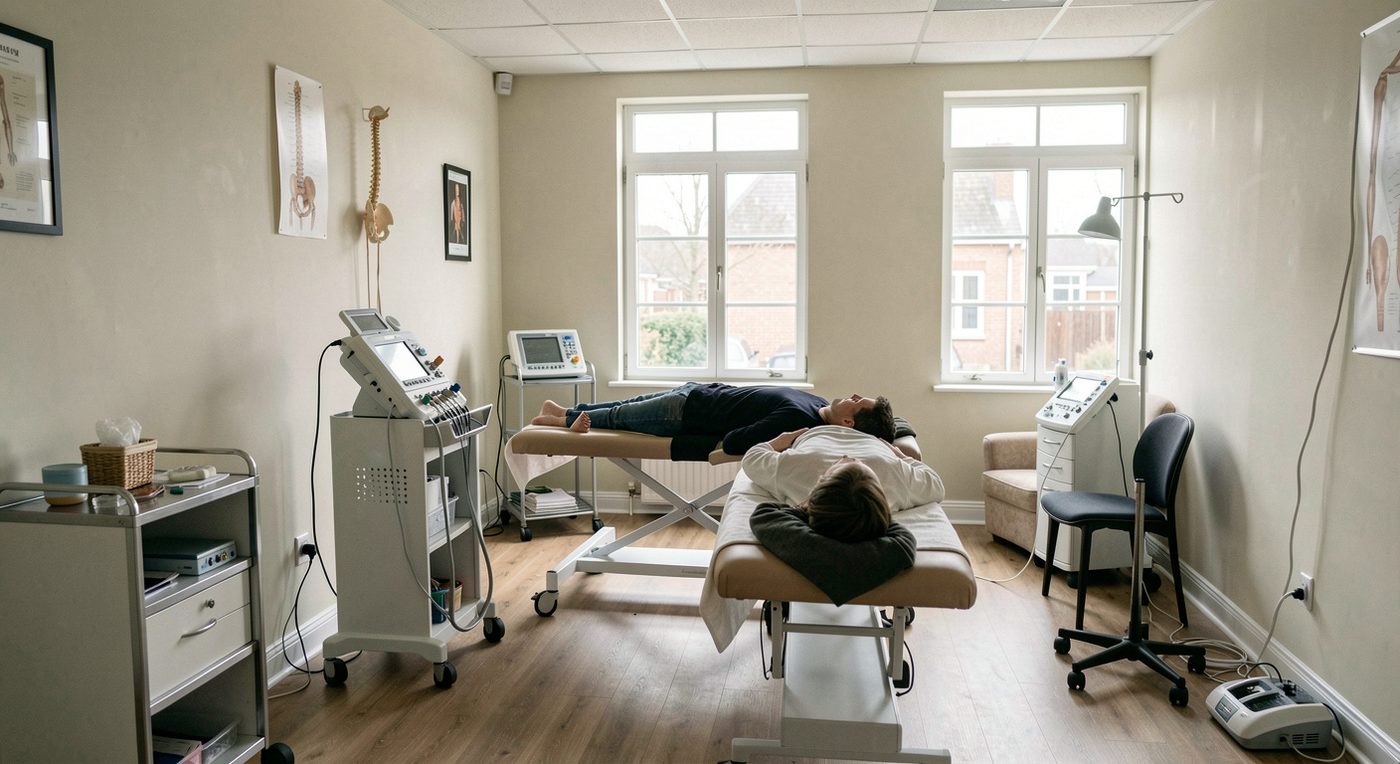
If back pain leads to an MRI, you will lie on a flat bed that moves through a short tunnel while a radiographer operates the scanner. The method uses no ionising radiation and the machine makes loud bangs and clicks, so the NHS notes that ear plugs or headphones are provided. You can read what happens during an MRI to understand how the pictures are made and why the appointment is run that way.
What follows is a starting set: six movements that can be begun while a back is still sore, done on a bedroom floor or a rug, with no equipment. They are deliberately unimpressive. The aim in the first fortnight is to restore confident movement, not to build strength, and the two need different approaches.
The soreness rule
The most useful thing on this page is not an exercise, it is the rule for judging them.
- During
- Mild discomfort is acceptable and expected. Think of it as tolerable rather than pain free. Sharp pain, or pain shooting down a leg, means stop that movement.
- Immediately after
- It should feel no worse than before starting, and often slightly easier.
- The next morning
- The real test. Any increase in soreness should have settled within twenty four hours. If it has not, do less next time rather than stopping altogether.
- Progression
- Add a few repetitions or one movement at a time, roughly every three or four days, once the previous level is comfortable.
Doing slightly too little for a week costs almost nothing. Doing far too much on day two costs a fortnight.
Six movements to start with
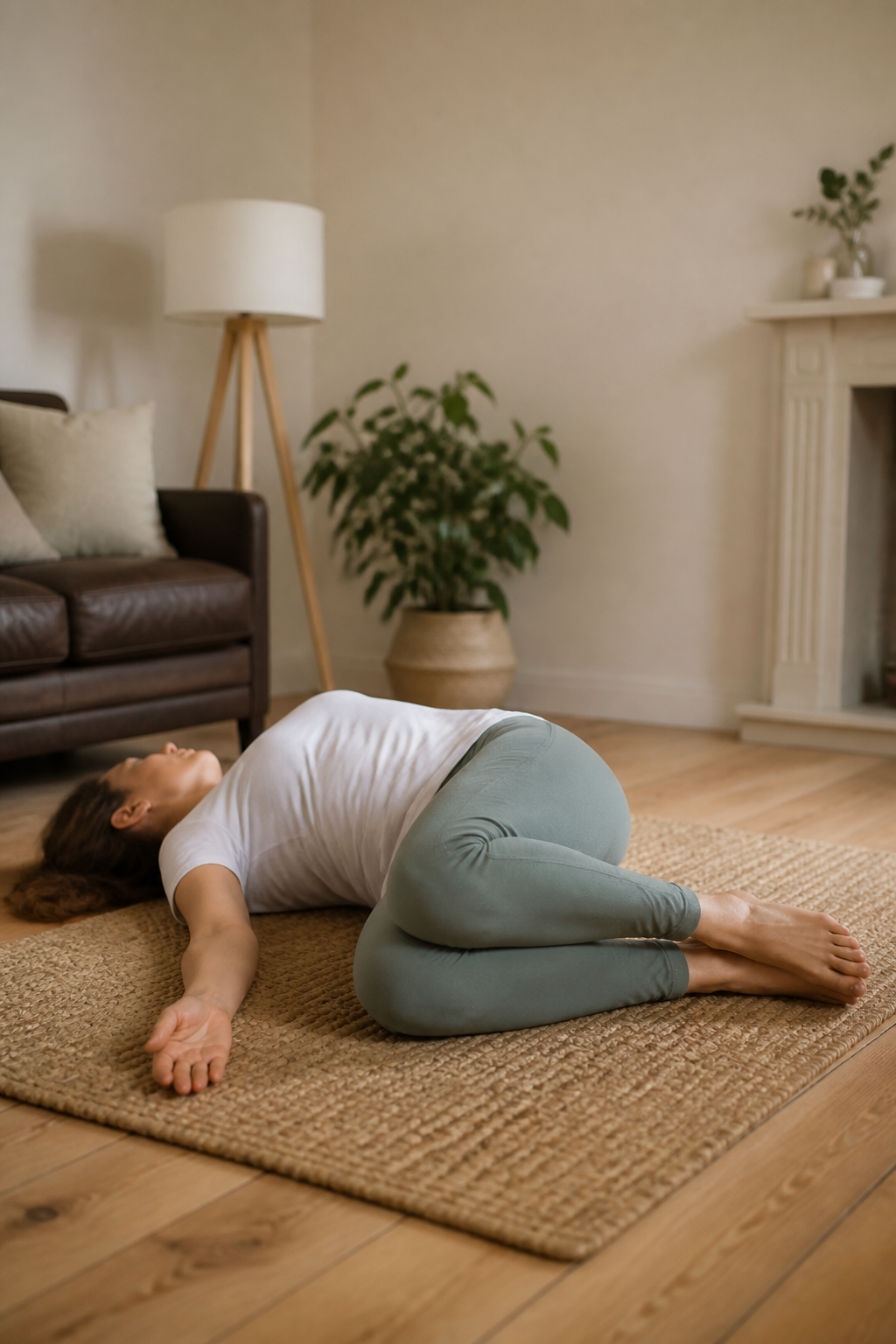
- Knee rolls. Lie on the back, knees bent, feet flat, arms out to the sides. Roll both knees slowly to one side as far as is comfortable, keeping the shoulders down, then to the other. Ten each way. This is usually the first movement people can manage and it does a great deal for early stiffness.
- Single knee to chest. Same starting position. Bring one knee towards the chest, hold gently with the hands for about ten seconds, lower and swap. Five each side. Never force it.
- Pelvic tilts. Knees bent, feet flat. Flatten the lower back gently into the floor by tilting the pelvis, hold three seconds, then release and allow the small natural arch to return. Ten repetitions, slowly. This teaches control of the position rather than stretching anything.
- Bridging. Knees bent, feet flat and hip width apart. Squeeze the buttocks and lift the hips a few inches from the floor, hold three seconds, lower slowly. Eight to ten repetitions. The lift comes from the buttocks, not from arching the lower back.
- Cat and camel. On hands and knees, slowly round the back upwards, then let it sag gently. Ten slow cycles. Smooth movement matters more than the size of the range, and it is one of the better ways to persuade a guarded back that movement is safe.
- Bird dog. On hands and knees, reach one arm forward while extending the opposite leg behind, keeping the trunk still, hold five seconds and swap. Five each side. Start with only the arm, or only the leg, if the full version is too much.
Two additions worth knowing about. A gentle prone press up, lying on the front and pushing up onto the forearms, suits some people with pain that runs into a leg and irritates others, so it deserves a cautious trial. And a standing back extension, hands on the hips, leaning gently backwards five times, is the one that can be done at a desk during the day.
How much, how often
Once or twice a day in the first two weeks, taking about ten minutes. Slow and controlled throughout, breathing normally rather than holding the breath, and stopping short of the point where the back starts to guard.
Daily beats intense. A back that is worked hard twice a week and left alone in between improves more slowly than one that is moved gently every day. As things settle, the floor routine can drop to a few times a week and be replaced by the more useful thing, which is ordinary movement in ordinary life.
What comes after the floor exercises
Floor exercises are a bridge, not a destination. Once the worst has passed, the evidence favours general activity and strength work, and it is refreshingly relaxed about which kind. Walking, swimming, cycling, yoga, Pilates, tai chi and gym based strength work all have supporting evidence. The best one is whichever will still be happening in six months.
A sensible progression looks like this:
- Weeks one and two. The six movements above, plus short walks, several times a day.
- Weeks three and four. Longer walks, and add sit to stands from a dining chair without using the hands, two sets of ten.
- Weeks five to eight. Add loaded movement: carrying shopping deliberately, a hip hinge practised unloaded then with a light weight, and step ups on the bottom stair.
- Beyond. Two strength sessions a week and 150 minutes of moderate activity, in line with UK Chief Medical Officers' guidance. This is the part that reduces the chance of the next episode.
What to leave alone for now
Not forever, and not because these movements are dangerous, but because they are a poor choice in the first fortnight of a painful episode.
- Full sit ups and straight leg raises, both of which load the lower back heavily for very little return.
- Standing toe touches with locked knees, particularly first thing in the morning when disc pressure is at its highest.
- Heavy lifting, and any lifting combined with a twist.
- Long static holds such as extended planks, which tend to be tolerated poorly early on.
- Anything that reproduces the sharp pain rather than a general ache.
Also worth knowing: bed rest is specifically not recommended, and back braces and corsets are not supported by current guidance. The instinct to protect the back by immobilising it is the one to resist.
If nothing is improving
Most episodes improve substantially within four to six weeks. If six weeks have passed with no change at all, or if the pain is preventing sleep or work, that is a reasonable point to see a GP. Many areas of England allow self referral to NHS physiotherapy, and a growing number of GP practices have a first contact physiotherapist who can be seen without a GP appointment first. Asking the receptionist what the local route is often saves a fortnight.
For anyone wondering where hands on treatment fits, UK guidance supports manual therapy alongside exercise rather than instead of it. What osteopathy involves and how the professions differ are covered separately.
Stop and get help today
Numbness or tingling around the back passage, genitals or inner thighs, difficulty passing urine, loss of bladder or bowel control, numbness or weakness in both legs, back pain with fever or unexplained weight loss, pain after a serious fall, or new back pain in someone with a history of cancer. In the UK, contact a GP or call NHS 111 without delay, and 999 if symptoms are severe or come on suddenly. What this site can and cannot do is set out on the medical disclaimer page.
Common questions
Should exercise be stopped if it hurts?
Not for mild discomfort that settles within a day. Stop for sharp pain, for pain shooting down a leg, and for any increase in soreness still present after twenty four hours, and reduce rather than abandon.
How soon after an episode starts is it safe to begin?
Gentle movement can usually start within the first day or two, at whatever level is tolerable. Guidance is consistent that early movement shortens episodes and that bed rest lengthens them.
Is Pilates or yoga better for backs?
Both have reasonable evidence and neither has been shown to beat general exercise. Attending a class that is genuinely enjoyable is worth more than choosing the theoretically optimal discipline and going twice.
Is walking enough on its own?
It is a good foundation and it is not the whole picture. Strength work on two days a week adds something walking cannot, which is the capacity to tolerate load.
What about exercises for a stiff morning back?
Knee rolls and pelvic tilts done in bed before getting up suit that well. The morning stiffness page covers why mornings are worse and when the pattern is worth reporting.
A gentle week still contains chores; small chores in a gentle week shows how to spread them.
Some chores are exercise in disguise; heavier jobs paced like exercise is the same principle outdoors.
The exercises on this page work best when they become part of a wider routine, and that routine often depends on where and how you live. A few minutes of movement each day is easier to keep up when the space around you supports it, and when family and neighbours know what helps. For older readers and those who look after them, housing and daily movement are treated together in a plain guide covering steady feet, everyday activity and the practical arrangements worth settling early.