
Almost everyone is stiffer in the morning than in the afternoon, and most of the time that is unremarkable. What makes the question worth a page is that a small proportion of morning stiffness follows a distinct pattern that UK guidance treats as a referral trigger, and the difference between the two is easy to describe and easy to miss.
The short version: stiffness that eases within half an hour of getting going is almost always ordinary. Stiffness that lasts longer than half an hour, improves with movement rather than rest, and has been present for months belongs in a GP appointment.
The normal explanation
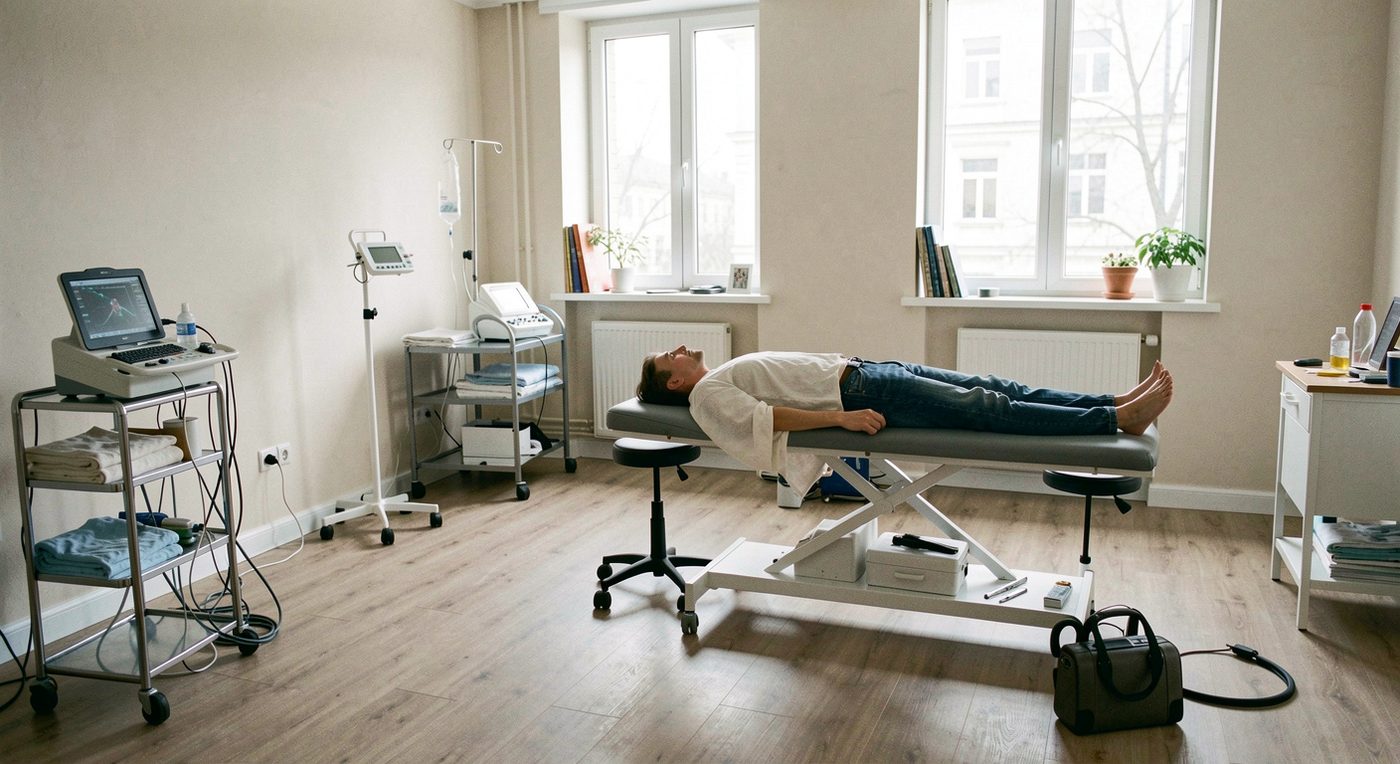
Several things happen to a body during seven or eight hours of lying still, and all of them point in the same direction.
- Discs take on fluid overnight. Spinal discs absorb water when the spine is unloaded, which is why most people are measurably taller first thing than at bedtime. It also means pressure inside the discs is at its highest in the first hour after waking, which is one reason bending to put socks on feels different at seven in the morning.
- Joint fluid is thicker at rest. Synovial fluid behaves differently when a joint has not moved for hours and thins with movement, which is the mechanism behind the sensation of a joint loosening up.
- Muscles cool and settle. A body that has been still and cooling for hours has less immediately available range than one that has been walking about.
- Positions are held for hours. Nobody chooses their three in the morning position, and some of them are ones nobody would choose.
None of that indicates damage, and all of it resolves with movement rather than with rest. Ten or fifteen minutes of ordinary morning activity is usually enough.
Ordinary morning stiffness is an argument for getting the kettle on, not for going back to bed.
The thirty minute rule
- Under 30 minutes
- Typical of mechanical stiffness and of osteoarthritis. Eases with gentle activity, worsens again after long periods of sitting still during the day.
- Over 30 to 45 minutes
- More suggestive of an inflammatory process, particularly if it is a consistent pattern over months rather than an occasional bad morning.
- Worse with rest, better with movement
- The characteristic pattern of inflammatory back pain, and the opposite of what most mechanical problems do.
- Waking in the second half of the night
- Pain that reliably wakes someone at three or four in the morning, easing when they get up and walk about, is a specific and important feature.
None of these on its own proves anything. Together they form a picture that clinicians recognise, and it is worth describing accurately when there is an appointment, because it is exactly the detail that gets lost in a rushed ten minutes.
The pattern that is worth reporting

NICE guidance on spondyloarthritis, a family of inflammatory conditions that includes ankylosing spondylitis, sets out fairly specific criteria for referral to a rheumatologist. It is unusual for a guideline to be this concrete, and it is genuinely useful for readers.
The starting point is low back pain that began before the age of forty five and has lasted longer than three months. Alongside that, clinicians look for a set of additional features:
- Back pain that started before the age of thirty five.
- Waking during the second half of the night because of the pain.
- Buttock pain, particularly alternating from side to side.
- Improvement with movement, rather than with rest.
- Improvement within forty eight hours of taking an anti inflammatory.
- A first degree relative with spondyloarthritis, psoriasis, inflammatory bowel disease or a related condition.
- Current or previous arthritis, enthesitis, which is inflammation where a tendon joins bone, or psoriasis.
Four or more of those features alongside the starting criteria prompts a rheumatology referral, and there is a specific route involving a blood test where three are present. Delays in diagnosing this group have historically been measured in years, largely because the pain is assumed to be ordinary back pain, so anyone who recognises this picture in themselves has good reason to describe it plainly to a GP.
Other reasons mornings are stiff
Beyond the mechanical and the inflammatory, several other explanations turn up regularly.
- Osteoarthritis, which typically produces stiffness lasting under half an hour, worst first thing and after periods of sitting, in specific joints rather than everywhere. Joint health with age covers what helps, and exercise sits firmly at the top of that list.
- Rheumatoid arthritis, which classically causes prolonged morning stiffness with swollen, tender small joints in the hands and feet, often symmetrical. Early assessment matters a great deal here.
- Polymyalgia rheumatica, almost always in people over fifty, causing marked stiffness and pain around the shoulders and hips that makes getting out of bed or raising the arms genuinely difficult in the mornings.
- Fibromyalgia, where morning stiffness sits alongside widespread pain, fatigue and unrefreshing sleep.
- Poor sleep itself. Broken or shallow sleep leaves people stiffer and more sensitive to pain the next morning, independent of anything happening in the joints.
- An unaccustomed day before, such as a long drive, a day of decorating or a first gym session in a year. That kind of stiffness peaks at twenty four to forty eight hours and then fades, which is its distinguishing feature.
A five minute morning routine
Done in bed and then on the bedroom floor, before the day starts properly.
- Knee rolls, lying on the back, knees bent, rolling them slowly side to side. Ten each way.
- Knee hugs, one knee at a time towards the chest, ten seconds each. Gentle, not forced.
- Pelvic tilts, flattening and hollowing the lower back slowly against the mattress. Ten repetitions.
- Sit on the edge and roll the shoulders, ten backwards, then five slow neck turns each way.
- Stand and do five sit to stands from the edge of the bed, without using the hands, and then walk about while the kettle boils.
Anyone whose back is currently acutely painful will find the gentle exercise page a more suitable starting point, since it sets out how much soreness is acceptable and when to stop.
What reduces it over weeks
Regular activity is the strongest lever, and the UK Chief Medical Officers' guidance of 150 minutes of moderate activity a week plus strengthening on two days is a reasonable target to build towards rather than to start at. Consistency matters more than intensity: a daily twenty minute walk does more for morning stiffness than a punishing session at the weekend.
Beyond that: protecting sleep, since poor sleep amplifies everything felt in the morning, keeping the bedroom warm enough that muscles are not cooling for hours, and breaking up sitting during the day, because a body that is stiff after eight hours in bed will be stiffer after eight more in a chair.
Stiffness that should be seen sooner
Morning stiffness lasting more than half an hour for weeks on end, stiffness with swollen or hot joints, stiffness with fever, unexplained weight loss or night sweats, new severe stiffness around the shoulders and hips in someone over fifty, or any of this alongside a new headache, jaw pain when chewing or changes in vision needs medical assessment rather than a stretching routine. In the UK, contact a GP or call NHS 111 without delay, and 999 if symptoms are severe or come on suddenly. What this site can and cannot do is set out on the medical disclaimer page.
Common questions
Is morning stiffness a sign of arthritis?
Not on its own. Almost everyone has some. What raises the question is duration over half an hour, a consistent pattern over months, swollen or hot joints, or stiffness that improves with movement and worsens with rest.
Does a mattress cause morning stiffness?
A sagging mattress can certainly contribute, and replacing one that is visibly past it is reasonable. Blaming a good mattress for stiffness that has been building for months usually leads to an expensive disappointment.
Should a hot shower come before or after the stretches?
Before, if the choice exists. Warmth makes gentle movement more comfortable, which means the movement is more likely to happen properly.
Why is it worse in cold weather?
Many people report it and the explanation is not fully settled. Cooler tissue is less compliant, and people move less and spend more time indoors in winter, which is probably the larger part of it.
Can stiffness be from sleeping too long?
Long periods of immobility do increase it, so a ten hour lie in can feel worse than a seven hour night. Regularly needing far more sleep than usual is itself worth mentioning to a GP.
A morning walk is one answer to a stiff start; walking the dog in the morning looks at what those miles do for a back.
And a working dog is its own alarm clock: a dog that does not let you lie in gets the stiff morning moving.