Anyone with a sore lower back has been told there is a correct way to sleep, usually by someone confident. The honest position is more modest: there is no single best sleeping position, there is a position that suits a particular back on a particular night, and there are a few small adjustments that make most positions considerably kinder.
What follows is what tends to work, why, and which parts of the advice are worth ignoring. It is worth saying plainly at the start that nobody controls what they do at three in the morning, and a plan that depends on holding one position all night will fail.
The short answer
- On the side
- A pillow between the knees, knees bent moderately. The most comfortable position for most people with low back pain, and the easiest to adjust.
- On the back
- A pillow under the knees, so the lower back is not pulled into an arch by straight legs. Excellent for some backs, poor for anyone who snores.
- On the front
- The least kind position for the neck and lower back, though not forbidden. A thin pillow under the abdomen and a very flat one, or none, under the head make a real difference.
- The general rule
- Keep the head, shoulders and hips in a reasonably straight line and fill the gaps rather than forcing the body into a shape.
Comfort is the measure. A position that is theoretically correct and keeps you awake is worse than a position that is theoretically imperfect and lets you sleep.
Side sleeping, and where the pillow goes
Most adults sleep on their side, and it is where most people with back pain end up. The problem it creates is at the pelvis: the upper leg falls forward and down across the lower one, which rotates the pelvis and twists the lower back for hours.
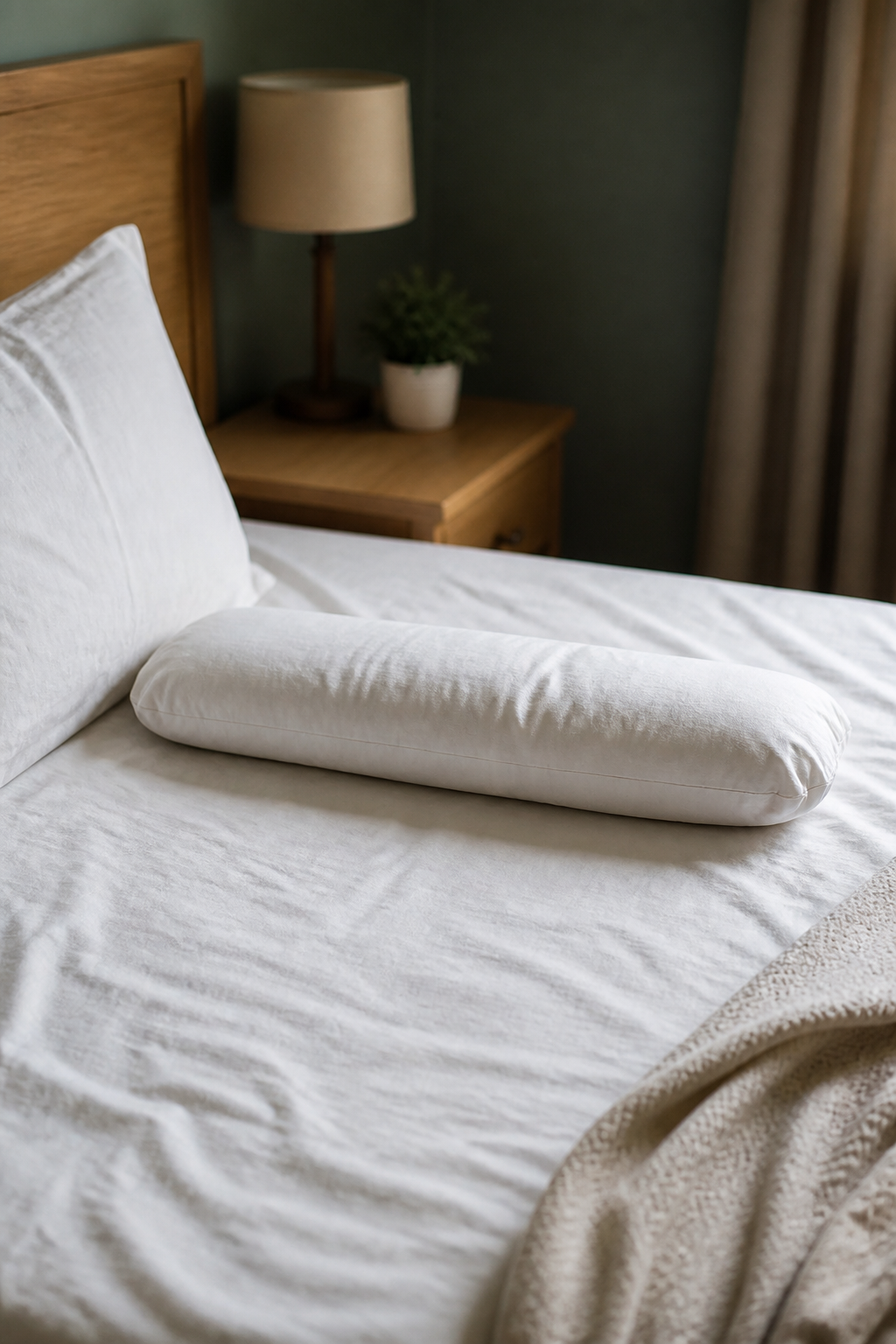
A pillow between the knees stops that. A firm one is better than a soft one, and it should run from the knees down towards the ankles rather than sitting only at the knee, otherwise the lower leg still drops. Anyone who owns a body pillow already has the right shape.
Knees should be bent moderately, not curled tightly to the chest. A full foetal position holds the lower back in flexion all night, and people who wake stiff and bent often find easing the curl helps. For sciatica, most people are more comfortable lying on the unaffected side, though this is not a rule and the opposite works for some.
One more detail worth knowing: the gap between the ear and the mattress in side lying is the whole reason side sleepers need a thicker pillow than back sleepers. More on that below.
Back sleeping
Lying flat on the back with the legs straight pulls the pelvis into a forward tilt and increases the hollow in the lower back, which is exactly the position that irritates a good number of sore backs. A pillow under the knees removes it, and for many people that single change transforms back sleeping from uncomfortable to the best option available.
A rolled towel under the small of the back suits some people and irritates others, so it is worth a trial rather than a purchase. The head pillow should be relatively flat: a thick pillow on the back pushes the chin towards the chest for eight hours, which is a decent recipe for a stiff neck.
Back sleeping is not suitable for everyone. It worsens snoring and obstructive sleep apnoea, and it is generally uncomfortable in later pregnancy, where side lying is the recommended position.
Front sleeping, and how to make it less costly
Sleeping face down requires the neck to be turned roughly ninety degrees for hours, and it tends to flatten the body into the mattress in a way that extends the lower back. It is the position most often described as the one to avoid.
Telling a lifelong front sleeper to stop is usually futile. More useful adjustments:
- Use a very thin pillow under the head, or none at all, to reduce how far the neck is extended.
- Put a flat pillow under the abdomen and pelvis, which takes the arch out of the lower back.
- Alternate which way the head is turned, rather than always the same side.
- Try a three quarters position instead: mostly on the front, with the upper knee drawn up onto a pillow. It keeps the feel of front sleeping without the full neck rotation.
Pillow height, which matters more than position
Pillows get far less attention than mattresses and cause considerably more trouble. The job is simple: keep the head in line with the spine, neither propped up nor allowed to drop.
Side sleepers need enough height to fill the distance between the ear and the outside of the shoulder, which for a broad shouldered adult is a good deal of pillow. Back sleepers need much less, often a single thin one. Front sleepers need almost none.
Two questions settle whether a pillow is wrong. First, is the head tilted up or down when lying in the usual position, checked by feel or by a photograph? Second, does the neck feel worse in the morning than it did at bedtime? A yes to the second, several days a week, is the clearest sign a pillow is not doing its job. The stiff neck page deals with what to do the morning after.
Mattresses, and what the evidence supports
The old advice to buy the firmest mattress available has not survived scrutiny. What research exists points towards medium firm as the most comfortable and the best supported for people with low back pain, and towards individual preference as a reasonable guide beyond that.
The practical version:
- A mattress that visibly sags in the middle, or that is more than roughly ten years old and no longer comfortable, is worth replacing.
- A perfectly good mattress that suddenly seems to be the problem usually is not. Back pain has often been building for weeks before it becomes noticeable at night.
- A very firm mattress can leave a side sleeper's shoulder and hip taking all the pressure, with a gap under the waist that the lower back has to bridge all night.
- A cheap topper is a sensible experiment before an expensive replacement.
- Shop returns policies matter more than showroom minutes. Nobody can judge a mattress in four minutes with their shoes on.
Getting in and out of bed without paying for it
For an acutely painful back, the moment of getting out of bed is often the worst of the day, and the technique is easy to learn.
To get out, roll onto the side first, keeping the shoulders and hips turning together rather than twisting. Drop the lower legs off the edge of the bed while pushing up through the arms, so the weight of the legs helps lift the trunk. To get in, reverse it: sit on the edge, lower onto the side using the arms, then bring the legs up together.
Discs absorb fluid overnight and pressure inside them is at its highest in the first hour after waking, which is a good reason to avoid heavy forward bending first thing. Putting socks on sitting down rather than standing and bending, and leaving the bed making until later, are small changes that pay for themselves during a flare up.
Night pain that needs looking at
Back pain that consistently wakes you in the second half of the night, pain that is worse lying down and eases when you get up, back pain with fever, unexplained weight loss or night sweats, numbness around the back passage or genitals, loss of bladder or bowel control, or new back pain in someone with a history of cancer are all different from a bad night's sleep. In the UK, contact a GP or call NHS 111 without delay, and 999 if symptoms are severe or come on suddenly. What this site can and cannot do is set out on the medical disclaimer page.
Common questions
Is sleeping on the floor good for a bad back?
There is no evidence that it helps, and it removes any give under the shoulder and hip, which most side sleepers find uncomfortable. People who report a benefit are usually escaping a badly sagging mattress rather than benefiting from the floor.
What position is best for sciatica?
Most people are most comfortable on the unaffected side with a pillow between the knees, or on the back with a pillow under the knees. There is no universal answer, and comfort is the right guide. Sciatica usually takes four to six weeks to settle, sometimes longer.
Does an adjustable bed help?
Some people with specific conditions find a slight incline at the head or knees genuinely helpful. There is little good evidence for adjustable beds as a general treatment for back pain, and they are expensive. A pillow under the knees replicates part of the effect for nothing.
Why is the pain worse first thing and better by mid morning?
Some morning stiffness is normal and mechanical. Stiffness that lasts more than half an hour, improves with movement rather than rest and has been present for months follows a different pattern worth discussing with a GP. The morning stiffness page explains the distinction.
How much sleep is enough?
Most adults need somewhere between seven and nine hours. Sleep quality matters as much as duration for pain, since poor sleep measurably lowers pain thresholds. Sleeping with persistent pain covers the loop between the two.
Position is only half the night; light in the last hour is the other half.
Sleep position is only one part of the picture. The month itself changes how you rest: warmer nights, lighter evenings and different meals all nudge the body in small ways. A position that feels right in January may feel wrong in July, and that is normal. Rather than forcing the same routine all year, it helps to notice what each season asks of you. Our guide to seasonal routines looks at how sleep, food and movement shift with the calendar, and how to keep those changes kind to an ordinary back.